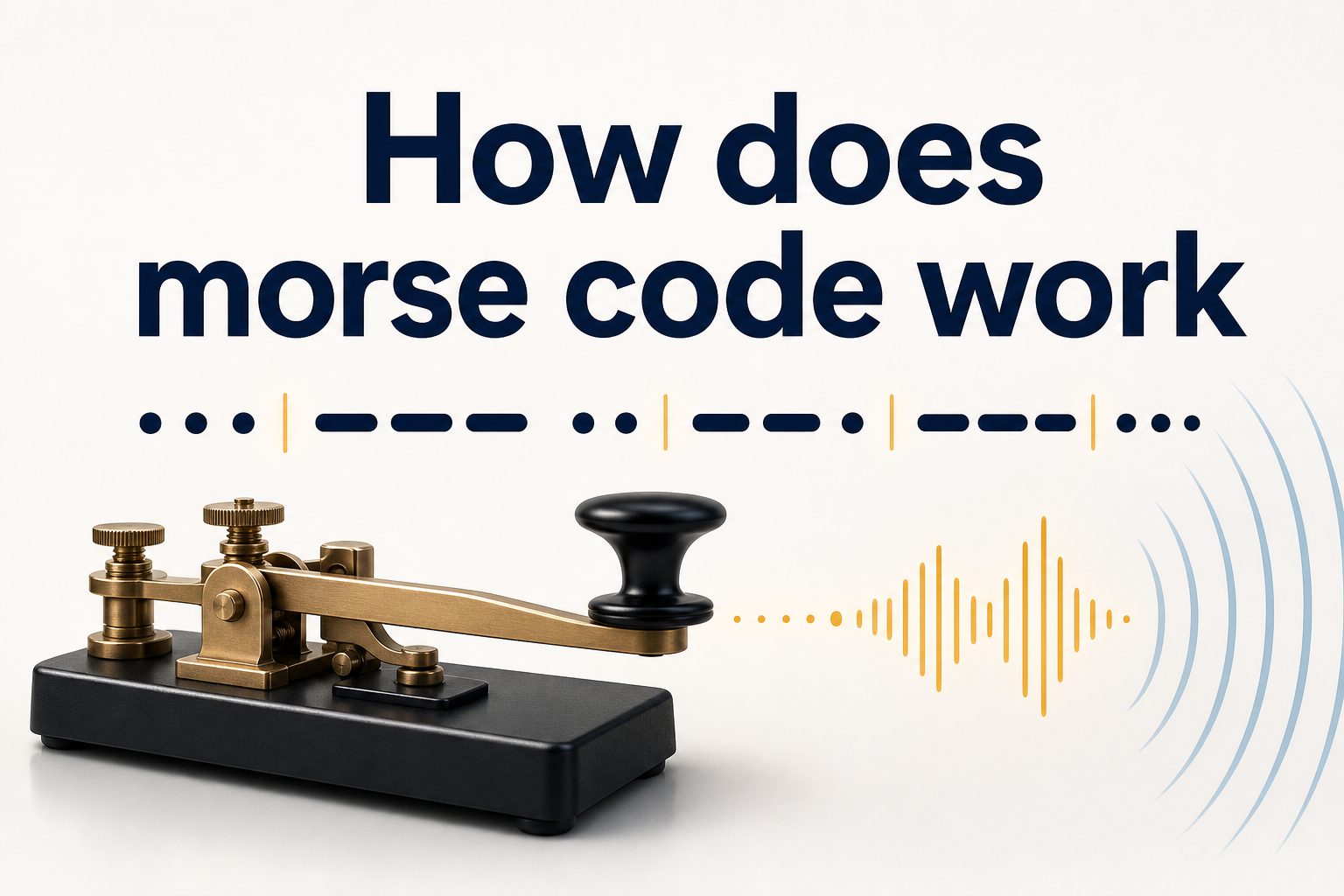
How does morse code work is a question many people ask when they first see dots and dashes written together. Morse code is a communication system that turns letters, numbers, and punctuation into short and long signals. These signals can be sent by sound, light, radio, touch, or written marks.
The short signal is called a dot, and the long signal is called a dash. Each letter has its own pattern. For example, A is dot-dash, while B is dash-dot-dot-dot. The system works because both the sender and receiver understand the same timing rules.
Morse code became famous because it helped people send messages over long distances before phones and the internet. It was used in telegraphs, ships, military communication, aviation, and emergency signals. Even today, people use it in amateur radio, survival situations, accessibility tools, and historical learning.
How does morse code work in real life? It works by combining rhythm, timing, and pattern recognition. Once you learn the sound of each letter, Morse code becomes less like memorizing symbols and more like hearing a language.
How does morse code work?
Morse code works by representing letters and numbers with short and long signals called dots and dashes. These signals are separated by timed pauses between parts of a letter, letters, and words. It can be sent using sound, flashing light, radio, or taps.
How Does Morse Code Work Without Modern Technology?
How does morse code work is best explained as a system that changes normal language into timed signals. Instead of sending full letters as speech or printed text, Morse code uses dots, dashes, and pauses. A dot is a short signal. A dash is a longer signal. Every letter and number has a unique combination, which allows messages to travel through sound, light, radio waves, electrical pulses, or physical taps.
The system depends on timing. A dash lasts about three times longer than a dot. The small pause between parts of one letter is short. The pause between letters is longer. The pause between words is longer still. These timing rules prevent confusion and make the message readable.
Morse code became important during the telegraph era because it allowed people to send information across wires over long distances. Later, ships, pilots, soldiers, and radio operators used it because it could travel through weak signals and noisy conditions. The famous emergency signal SOS became widely known because it is simple, clear, and easy to send.
Today, Morse code is no longer required for most professional communication, but it still has value. Amateur radio operators use it because it works with low power and narrow bandwidth. Survival experts study it because it can be sent with a whistle, flashlight, mirror, or tapping sound. Some people with limited movement also use Morse-based input systems to communicate.
How does morse code work for beginners? It works best when learners hear the rhythm instead of only memorizing written dots and dashes. Common letters such as E, T, A, I, N, and M are good starting points. With practice, the patterns become familiar, and the listener begins to recognize whole letters by sound.
How Does Morse Code Work Through Dots, Dashes, and Timing?
Morse code works by assigning a unique signal pattern to each letter, number, and common punctuation mark. These patterns use two basic signal lengths: the dot and the dash. A dot is short and quick, while a dash lasts longer. When arranged in different combinations, these two simple signals can represent full written language.
The system is powerful because it does not depend on speech, handwriting, or modern screens. A person can send Morse code with a telegraph key, a radio tone, a flashlight, a whistle, a mirror, or even taps on a wall. This flexibility explains why Morse code remained useful for so long in travel, military work, maritime safety, and emergency communication.
Timing is the real structure behind Morse code. The pauses matter as much as the dots and dashes. Without pauses, the receiver could not tell where one letter ends and another begins. A short pause separates dots and dashes inside one letter. A medium pause separates letters. A longer pause separates words.
How does morse code work when sent by sound? The receiver listens to the rhythm. For example, the letter E is one dot, while T is one dash. The letter S is three dots, and O is three dashes. That is why SOS is so recognizable: dot-dot-dot, dash-dash-dash, dot-dot-dot.
A beginner should not think of Morse code as a secret code only for experts. It is a compact signaling language. Once the learner understands rhythm and spacing, the system becomes easier to read. The goal is not to count every dot and dash forever. The goal is to hear each letter as a sound pattern.
Morse code also teaches an important communication lesson: clarity often comes from simplicity. With only two signal types and carefully measured silence, people can send useful messages across distance, noise, darkness, and technical limits.
Why Does Morse Code Still Matter Today?
How Morse Code Works in Emergencies
Morse code still matters because it can work when other systems fail. A phone needs battery power, signal coverage, and a working network. Morse code can be sent with basic tools. A person stranded outdoors can flash a light, blow a whistle, or tap a pattern to attract attention.
How Morse Code Works on Radio?
Amateur radio operators still value Morse code because it travels well through weak radio conditions. A Morse signal can often be understood even when voice communication is unclear. This makes it useful for long-distance radio contacts and low-power communication.
How Morse Code Works for Accessibility
Some assistive technologies use Morse-style input because it can be controlled with very limited movement. A person may use one switch, two switches, eye movement, or touch patterns to enter text. In that setting, Morse code becomes more than a historical skill. It becomes a practical communication bridge.
How Morse Code Works as a Learning Tool
Learning Morse code builds memory, rhythm, focus, and listening skills. Students can use it to understand early communication technology, signal systems, and information encoding. It also shows how complex messages can come from simple building blocks.
When Should You Use Morse Code?
Morse code is useful when speech, screens, or normal writing are unavailable. It is not always the fastest tool, but it is reliable in special conditions. How does morse code work best? It works best when the sender and receiver both know the timing rules and can repeat signals clearly.
- Use Morse code during emergencies when you can only send light, sound, or tapping signals.
- Use Morse code in amateur radio when voice signals are weak or noisy.
- Use Morse code for outdoor survival practice because it can be sent with simple tools.
- Use Morse code in classrooms to teach communication history and signal encoding.
- Use Morse code for accessibility when a person needs a low-movement input method.
- Use Morse code for puzzles, games, escape rooms, and historical demonstrations.
Emergency signaling: SOS remains the most famous Morse signal because it is easy to remember and hard to mistake.
Long-distance communication: Radio operators can send Morse over impressive distances using modest equipment.
Silent communication: Tapping patterns can send messages without spoken words.
Visual signaling: A flashlight or mirror can send messages across a distance when sound cannot carry.
Skill training: Morse code helps learners understand rhythm, pattern recognition, and message structure.
How Does Morse Code Work Step by Step?
Morse code begins with a message. The sender chooses the words and breaks them into letters. Each letter is then converted into its Morse pattern. For example, C becomes dash-dot-dash-dot, while D becomes dash-dot-dot. Numbers also have assigned patterns, so full messages can include dates, times, coordinates, and instructions.
Next, the sender transmits each pattern with correct timing. A dot is the shortest unit. A dash lasts about three dot units. The gap between parts of one letter is one dot unit. The gap between letters is about three dot units. The gap between words is about seven dot units. These rules keep the message organized.
The receiver listens, watches, or feels the signals and converts them back into letters. At first, beginners may write down dots and dashes before translating them. With practice, experienced users recognize the sound directly. They hear dash-dot as N or dot-dash as A without needing to count.
How does morse code work at higher speed? Skilled operators learn whole sound patterns. They stop thinking in written marks and begin recognizing rhythm. This is similar to reading words instead of spelling every letter. Speed comes from familiarity, repetition, and clean spacing.
The most important part is consistency. If dots are too long, dashes are too short, or pauses are uneven, the message becomes confusing. Clear Morse code is not just about knowing the alphabet. It is about sending with steady rhythm.
How Does Morse Code Work for Beginners?
Learn the Shortest Letters First
Start with E, T, I, M, A, and N. These letters use simple dot and dash patterns, so they help you understand the structure quickly. E is dot, and T is dash.
Practice the Sound, Not Just the Symbols
Do not only memorize printed dots and dashes. Listen to Morse audio. The rhythm helps your brain recognize letters faster than visual memorization alone.
Use Common Words
Practice words such as “cat,” “time,” “radio,” and “signal.” Short words help you connect letters into real messages.
Keep Your Timing Clean
Good spacing makes Morse code readable. A correct pattern with bad pauses can still confuse the receiver.
Review Every Day
Ten focused minutes a day works better than one long session once a week. Repetition turns patterns into memory.
Conclusion
Understanding how Morse communication works is easier when you see it as rhythm, timing, and pattern recognition. Morse code turns letters into dots and dashes, then uses pauses to separate letters and words. It remains useful because it is simple, flexible, and reliable. How does morse code work is not only a historical question. It is also a practical lesson in clear communication.
FAQs
What is Morse code?
Morse code is a system that represents letters, numbers, and punctuation with dots, dashes, and pauses.
How does morse code work with light?
A short flash represents a dot, and a longer flash represents a dash. Pauses separate letters and words.
Is Morse code hard to learn?
It takes practice, but beginners can learn basic letters quickly by listening to the rhythm and practicing daily.
Why is SOS used in Morse code?
SOS is easy to send and recognize because it uses three dots, three dashes, and three dots.
Can Morse code still be useful today?
Yes. It is useful in amateur radio, emergencies, survival training, accessibility tools, and education.
What is the best way to learn Morse code?
The best way is to practice by sound, learn simple letters first, and use short daily sessions.